Continuous Provision or Constant Change?
Discussing the core purpose of continuous provision and reflecting on the question of whether enhancements develop or inhibit learning.
Continuous Provision or Constant Change? The Question Every Reception Teacher Needs to Ask This Term
For the last few weeks I've noticed something on social media that's made me stop and think. So many Reception teachers appear to be anxious about planning and running their classrooms, and there's a real sense that people are struggling. It's not helped by a constant stream of picture-perfect environments — fresh trays, a new small-world set-up, a role-play area rebuilt overnight to match this half-term's topic. It's a lot, and it can leave you feeling like you're not doing enough. But it's worth asking a hard question: has any of this actually helped you understand a child's learning, or has it just given everyone something new to look at?
That question sits at the heart of one of the most persistent confusions in early years practice — the difference between continuous provision and enhancements, and what each is actually for.
Two different jobs, not two names for the same thing
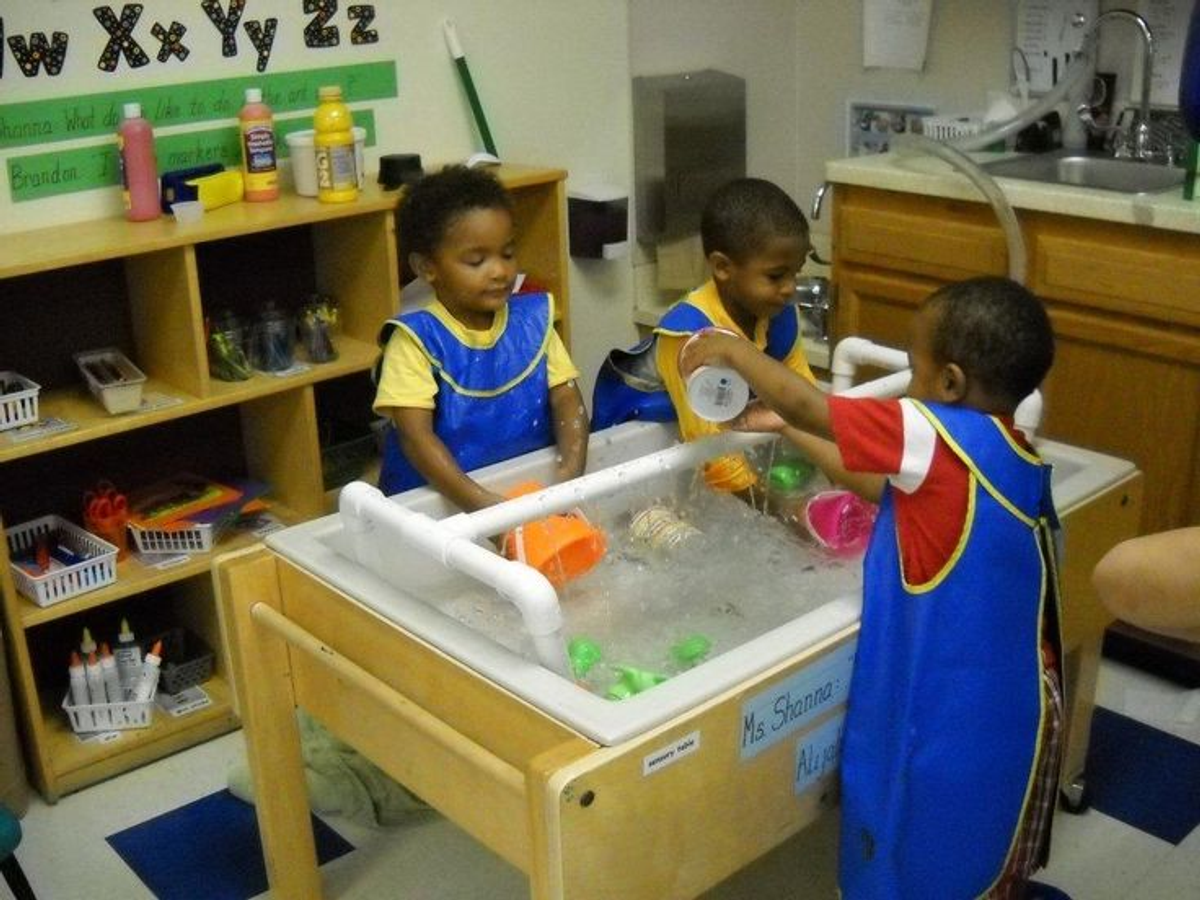
Continuous provision is the core resourcing of an area, the sand and water, the mark-making station, the construction area, that stays available every single day. Enhancements are the additions on top: new props in the role-play corner, a challenge card in the maths area, seasonal materials on the tuff tray. Most practitioners can define the two easily enough, so the confusion isn't really about definitions, it's more about function.
One of the most common myths in practice is that continuous provision needs to be changed often to stay engaging, and that enhancements are what actually move learning on. I'd argue the opposite: children get far more out of resources once they've had time to properly explore them and make them their own, and watching how they use those familiar resources tells you far more about their development than anything new you could add. Enhancements are meant to be flexible and short-lived, added in response to something specific. Continuous provision is meant to hold still, so everything else can be measured against it.
None of this is happening in a vacuum
It's worth saying plainly why this confusion is so widespread right now. Planning is one of the most exhausting parts of the job, and the numbers back up what most Reception teachers could already tell you: in the Department for Education's most recent survey, 86 per cent of teachers and leaders said they experience stress at work, and workload was the most common reason among the roughly three in ten considering leaving the profession altogether (Department for Education, 2025b). Scroll through any early years Facebook group or TikTok feed and it matches the data, exhausted practitioners, set against a stream of beautifully staged provision that quietly implies everyone else is managing to do more.
Rebuilding continuous provision every week isn't a sign of a strong teacher. It's often a symptom of the same pressure that's pushing people out of the sector — it just relocates the exhaustion from the classroom into the evening, without making the provision any more useful to the children in it. I think it's time we had a more honest conversation about continuous provision, and that starts with permission: permission to stop, to leave things be, and to trust that stability isn't the same as low effort.
Why the constancy is the point
A child who returns to the same construction area for the fourth week running isn't failing to be stimulated — they're doing exactly what continuous provision is designed to let them do: revisit, extend and consolidate a skill at their own pace, without an adult directing it. That pattern of return is data. It's the clearest evidence you have of independent learning, because it isn't performed for an adult, it's what a child chooses when no one's asking them to. Change the resource every week and that evidence disappears; what's left is a record of novelty-seeking and compliance, not of learning and development.
The EYFS framework sets out three characteristics of effective learning that this kind of observation depends on: playing and exploring, active learning, and creating and thinking critically (Department for Education, 2025a). None of these can be reliably read against a constantly shifting backdrop, because a child behaves differently in a familiar environment than in a new one, and only one of those readings tells you anything real about them.
When the enhancement becomes the ceiling
The workload pressure explains why over-planning happens, but it's worth being honest about the effect it has too. Because enhancements are usually designed by an adult, they can easily turn into adult-led activities dressed up as play. A genuinely open enhancement such as a new material or prop still lets a child decide what to do with it. One built around a specific outcome, with an instruction attached, sets a ceiling on the activity before the child has even touched it. They can meet the adult's target or fail to, with very little room to go anywhere else — and not much reason to try.
That inverts exactly what continuous provision is meant to protect: pace, ownership, the opportunity for collaboration and problem solving and the freedom to arrive somewhere unplanned. When the outcome belongs to the teacher rather than the child, an enhancement can just as easily hold a child back as move them forward. Research behind the EYFS framework backs this up — children make the strongest, most lasting gains when adult input builds on what they've already started, rather than replacing it with a fixed task (Sylva et al., 2004).
The over-planning trap
In practice, this is a direct result of over-planning. A half-term topic web gets built first, enhancements are mapped against it week by week, and continuous provision becomes the backdrop that flexes around the theme rather than the other way round. It's an understandable instinct under pressure — a fully planned calendar feels rigorous — but it has the sequence backwards.
The right order runs the other way: observe what's happening in continuous provision, notice the interest or the gap, then decide whether a small, open-ended enhancement is worth adding. A useful test is whether children would still choose to use it with no adult prompting them, and whether more than one outcome is genuinely possible. If the answer to either is no, it's decoration or instruction, not enhancement.
Julie Fisher's work on the transition into Year 1 makes a related point: very little changes developmentally in a child over that single year, and it's continuity — not change — that lets learning build rather than reset (Fisher, 2016). A classroom that rebuilds its provision every fortnight works against the stability that supports a child's progress, well beyond Reception.
If you are one of those Reception class teachers who feel pressured to keep planning and enhancing provision - just know that it is ok to stop doing that and in fact it might even be better if you do. Give yourself time to observe the learning and have confidence that your continuous provision is doing the job it is intended to do. Less planning, less stress, less work in the evenings is going to help you enjoy the job more, focus on what the children are learning and hopefully help you find the joy again!
Questions worth asking before half-term
- Could you say what's deliberately stayed the same in your provision this half-term, and why?
- When you last added an enhancement, what observation prompted it?
- Does it leave room for a child to take it somewhere you didn't plan, or is there only one 'right' way to finish it?
- If a supply teacher walked in tomorrow, would your continuous provision still make sense without you there to explain it?
- Are you spending enough time observing how children use resources and how they adapt them to notice the learning?
None of these have one right answer — that's rather the point. But they're a useful check against the pull toward constant change, which usually comes from good intentions rather than good pedagogy. I'd love to hear how other settings are managing this balance, especially if there are external forces pulling them to plan more and more. Get in touch, let's talk about it!
References
Department for Education (2025a) Early years foundation stage (EYFS) statutory framework: for group and school-based providers. London: DfE.
Department for Education (2025b) Working Lives of Teachers and Leaders: Wave 4, Summary Report. London: DfE, IFF Research and UCL Institute of Education.
Fisher, J. (2016) Moving On to Key Stage 1: Improving Transition from the Early Years Foundation Stage. Maidenhead: Open University Press.
Sylva, K., Melhuish, E., Sammons, P., Siraj-Blatchford, I. and Taggart, B. (2004) The Effective Provision of Pre-School Education (EPPE) Project: Final Report. London: DfES / Institute of Education.