Compliant or Good? - Is there a difference?
This September brings three big Early Years changes at once — a new EYFS framework, revised Ofsted toolkit, and Experts at Hand. But are leaders losing sight of what actually helps children thrive?

Compliant or Good? - Is there a difference?
Every September brings a reset in the Early Years sector, but this one feels bigger than ever. From 1 September 2026, three things land at once: an updated EYFS statutory framework, a revised Ofsted inspection toolkit, and the early rollout of Experts at Hand — the government's new scheme bringing speech and language therapists, occupational therapists, and educational psychologists into mainstream settings. That is a whole lot of change and a leadership team could be forgiven for spending the whole autumn term just trying to keep up with what's changed on paper and making sure they are fully compliant, so why is that bothering me?
The compliance trap
I've watched this pattern play out for forty years: a framework changes, new guidance is published, a new toolkit lands, and settings go into readiness mode. Social media sites are full of requests for updates and ideas, as policies get rewritten, and staff are briefed accordingly. But somewhere in that scramble, sometimes the actual point of the change quietly gets lost.
This year's Ofsted toolkit introduces a new baseline requirement: a setting now has to be fully meeting the relevant EYFS statutory requirements before it can be graded “expected standard” in any area at all. That's a meaningful shift — it means a setting that's doing genuinely strong inclusive practice but has a paperwork gap somewhere could now find that gap affecting their whole grade, regardless of what's actually happening for children in the room.
I understand why that safeguard exists, but I've sat across the table from enough leaders to know what happens next: the focus becomes “are we compliant?” instead of “are we actually doing this well?” Those are not the same question, and settings that only answer the first one tend to do worse on inspection, not better — because inspectors can tell the difference between a policy that's been rewritten to match new wording and a practice that's genuinely changed.
Where I think the real opportunity is
Experts at Hand is, on paper, one of the more promising things to come out of this round of reform. Early access to speech and language therapists and educational psychologists inside mainstream settings, rather than children waiting months for a referral, is the kind of change that could genuinely shift outcomes for children. But it is worth noting that this isn't a single national service switching on in September. It's £1.8 billion over three years, handed to local areas as a grant, with each local authority and its health partners deciding their own priorities and phasing them in over time. Some areas are starting with a handful of pilot communities; others are moving faster. What “Experts at Hand” means for a setting in one postcode this term may look nothing like what it means twenty miles away — and that gap won't close quickly. Full implementation isn't expected until year two, with the wider ten-year reform not landing in law until 2029. This means leaders can't plan on a fixed, guaranteed level of specialist input arriving this September — they need to find out, specifically, what their own local area partnership has committed to delivering first, and treat anything beyond that as a bonus rather than a baseline. It also means the sector's usual inequality — where well-resourced areas get well-resourced support and everyone else waits — could quietly repeat itself inside a scheme that was explicitly designed to reduce exactly that kind of postcode variation.
None of that is a reason to wait and see. The leaders who'll get real value from Experts at Hand this year are the ones who chase down exactly what their local offer actually includes rather than assuming it matches the national headlines. The leaders who wait to be told what to do, or who assume their setting will get what the press release describes, risk being caught out by a rollout that was always going to be uneven by design.
Don't lose the child in the framework
Here's what worries me most about a compliance-heavy autumn: it's very easy to have every policy word-perfect and still miss the child.
Bronfenbrenner's ecological systems theory (Bronfenbrenner, 1979) has sat behind my thinking for most of my career, and it's never felt more relevant than it does right now. His argument was simple but easy to forget under pressure: a child doesn't develop in isolation, and they don't develop primarily through their interaction with a framework. They develop through the quality of the relationships around them — first with family, then with key workers and practitioners, then the wider setting and community, all the way out to the policies and systems that shape what's possible in that room. Change any layer without attending to the relationships running through it, and you get compliance without impact.
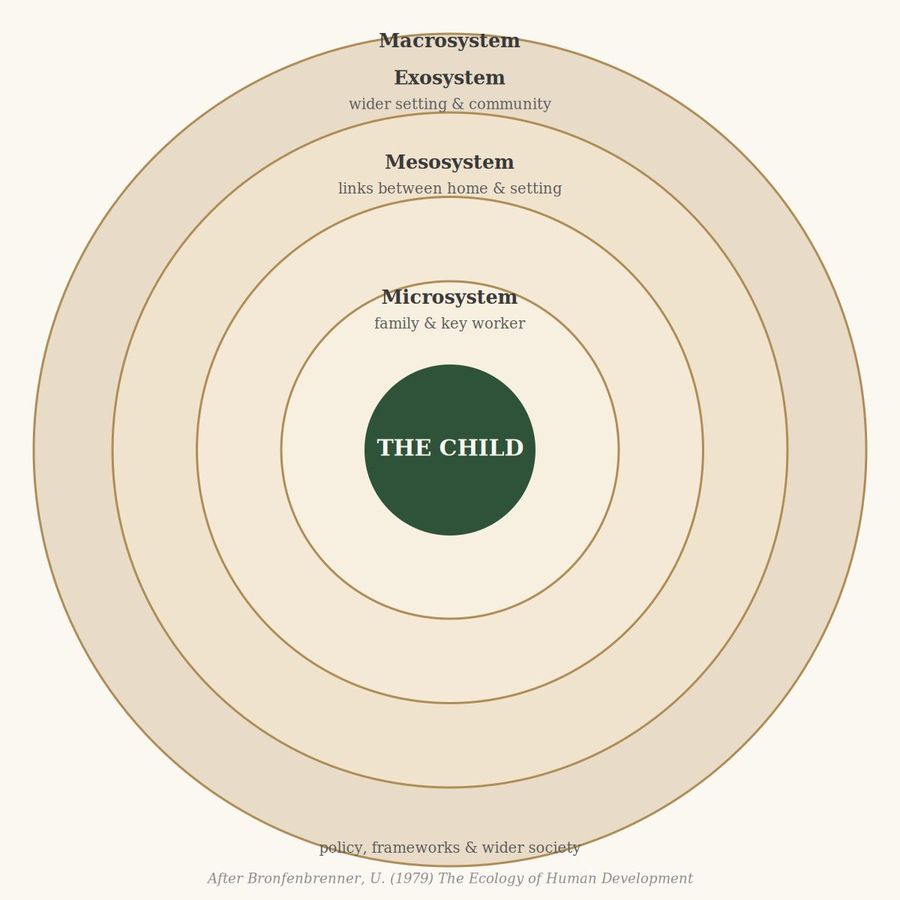
Bronfenbrenner's ecological systems model — the child develops through the quality of relationships at every layer, not through the framework itself.
This is exactly where I think Experts at Hand will succeed or fail. A speech and language therapist coming into a setting isn't, on its own, an intervention that changes a child's trajectory. What changes a child's trajectory is a key worker who already knows that child's family, who can carry the therapist's advice into the daily relationship the child trusts, and who keeps the family genuinely involved rather than informed after the fact. It is the quality of the relationships and how they complement each other that makes the difference. Without this the most well-funded specialist support in the world will underperform.
Children do not thrive because a setting adopts the right policy. They thrive when practitioners build real, trusting relationships with families who sometimes have every reason not to trust institutions, and when that relationship becomes the channel through which the specialist input, the curriculum, the extra support — actually reaches the child. No framework update changes that; it's still the actual work.
My honest read for this autumn
If I were advising a leadership team walking into this September, I'd say: do the compliance work properly, because you have no choice and it protects you, but don't let it become the term's main event. Protect time, deliberately, for the conversations about why you're doing what you're doing with the children who need the most from you. That's the work that was already good practice before any framework changed, and it's the work that will still matter after this one is superseded by the next.
The sector is constantly changing, but what doesn't change is that the leaders who ask “is this actually helping the child in front of me?” tend to build settings that thrive under any framework, and the ones who only ever ask “does this pass” tend to be permanently anxious about the next inspection, no matter how many boxes get ticked.
I'd genuinely like to know: if you're leading a setting or a school right now, is this matching what you're seeing? Is the SEND and inspection reform landing as opportunity, extra burden, or both?
Maureen Hunt is an early years consultant, keynote speaker, and author of Helping Every Child to THRIVE in the Early Years: How to Overcome the Effect of Disadvantage (Routledge).
References
Bronfenbrenner, U. (1979). The Ecology of Human Development: Experiments by Nature and Design. Harvard University Press.